
vBSDCon, the newest BSD conference, happening in October and in Virginia, has a new website. (via)
There’s another BSDTalk episode up already, because Will Backman’s at BSDCan 2013 and talking to Scott Long, Alistair Crooks, and David Discher, about NetFlix. Apparently there’s streaming video available now from the convention, and some people’s presentation slides have shown up.
Michael W. Lucas has two bits of mostly-BSD-centric publishing news. One is that a physical version of his DNSSEC Mastery book is now available through Amazon.
The other bit is that, having just released an Absolute OpenBSD update, his Absolute FreeBSD book will not see an update… until the FreeBSD installer gets more coherent.
(If you manage DNS in any fashion, buy DNSSEC Mastery.)
BSDTalk 225 has 12 minutes of conversation with Kris Moore about PC-BSD, recorded at BSDCan 2013, which is going on right now.
The tpm(4) driver has been added by Sascha Wildner, ported from FreeBSD. What’s it do?
From the man page: “The tpm driver provides support for various trusted platform modules (TPM) that can store cryptographic keys.” Crypto keys stored in hardware, where they are in theory unmangleable, instead of on the disk. At least, that’s my impression after 30 seconds of research.
Sepherosa Ziehau has posted some numbers showing improvements in ip forwarding rates. He’s done this before, except this time it’s with bnx(4), probably because of his recent commits.
Michael W. Lucas recently wrote and self-published a new book, DNSSEC Mastery. He asked me to review it, and I’ve been reading it in bits and starts over the past few very busy weeks.
First, the background: If you’re not familiar with the acronym, it’s a method of securing DNS information so that you can trust that domain name information is actually from the machine that’s supposed to provide it. DNS information is basic to Internet operation, but it traditionally has been provided without any mechanisms to deal with misinformation or malicious use. This seems to happen with protocols that have been around for many years, as any mail administrator can tell you…
In any case, ‘DNS poisoning’ (or as Wikipedia calls it, ‘DNS Spoofing‘) attacks such a basic part of how the Internet works that it will completely bypass any security methods that assume name information is correct. DNSSEC is a way to deal with that. It introduces public-key encryption into the process of sharing and updating DNS information. The idea has been around for a while, but it’s only been completely implemented recently.
DNSSEC Mastery goes over this history, and through the setup required to get (recent) BIND working with DNSSEC. Lucas seems to be starting a series of ‘Mastery’ books, where he covers all the territory around a specific topic. This one, like his previous title, is exactly what it says. As long as you have some existing clue around zone files and DNS, the book will take you from no DNSSEC at all to fully implemented in less than 100 pages. (well, at least in the PDF version, but that gives you an idea of the size.)
Use it to learn, or use it as a quick reference – either way will work. If you have any DNS server(s) to manage, you’re the target audience. I expect DNS without these security extensions will go the way of telnet vs. ssh.
A book covering things like new encrypted hash zone record types is going to be a bit dry, but there’s an appropriate sprinkling of humor through the book. I’ve reviewed other Lucas books before, and I’ve got another on my plate right now, but this is the same: there’s plenty of funny to make the lessons go down easier.
DNSSEC Mastery: Securing the Domain Name System with BIND is available on Amazon, Barnes & Noble, Smashwords, and his self-publishing site. Also see Peter N. M. Hansteen’s review of the book.
I’m inexplicably short on links this week; I blame my schedule/the nice weather for much for much of the U.S./the class I’m teaching ending/my trip to TCAF for this. More Lazy Reading next week! Meanwhile, I have a book review coming up as an alternative.
John Marino managed to update GCC from 4.7.2 to 4.7.3 (4.7 changelog), zlib from 1.2.7 to 1.2.8 (changelog), and awk from 20110810 to 20121220 (can’t find a changelog).
In other update news, Matt Dillon has been working on HAMMER2’s flush sequencing.
Update: tcsh too.
In the week after DragonFly 3.4 was released, Francois Tigeot was tracking downloads for each type of packaging system. It looks like dports downloads far outnumber pkgsrc. I think there’s reasons it appears different in uptake, but it’s still neat to see people trying the new system.
As seen on Author Michael W. Lucas’s blog: Absolute OpenBSD 2nd edition is 50% off in a sort of ‘flash deal’. Grab it today if you are interested, cause I think it’s only for today.
Ansible seems to be a configuration management system that’s lighter than puppet or salt. I had a student talking about it in my class tonight. BSD users Hubert Feyrer and Michael W. Lucas have both posted about it recently. Anyone want to repeat their experiences?
If you were perhaps thinking of setting up transmission-daemon, a BitTorrent server, this post on pkgsrc-users@netbsd.org will help you out.
If you have a sili(4) device, Francois Tigeot needs you to run a particular patch and tell him what happens. He’s testing a larger I/O request size, and wants to see how it will work out “in the field”.
Lots of links, not a lot of commentary, this week. Enjoy!
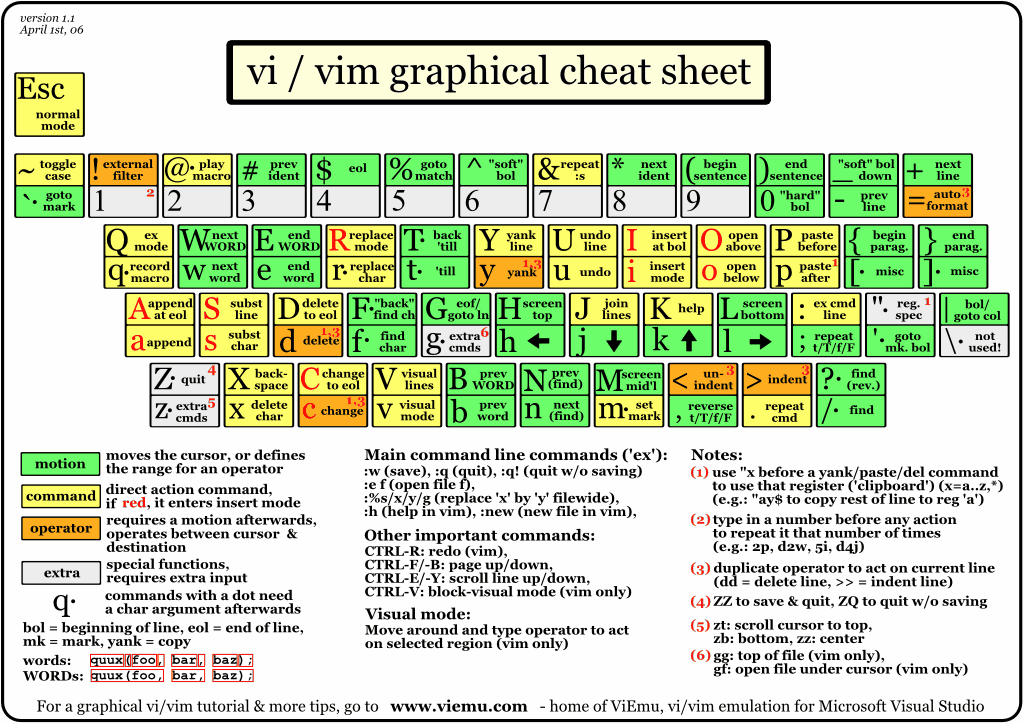
- What is your most productive shortcut with Vim? The first very extensive answer is actually all vi, not vim. (via)
- Found via previous link: vi / vim graphical cheat sheet.
- The site where that image site sells a vi emulator for Visual Studio/Word/Outlook. I can totally understand why you’d want that.
- Memory of a Broken Dimension, a game that starts as a command-line shell and breaks out into a 3D glitchy world. This is what Tron should have been. Mac/Windows only right now, unfortunately. (via)
- TCP Headers in Lego. (via)
- The History of ASCII art. (via)
- QWERTY, DVORAK, KALQ.
- Greytrapping.
- “Hey, a dot out!“
-
Futuristic User Interface 14: Primitive Computer Visualisation [sic]
Your unrelated link of the week: Baman Piderman. It’s a series of Youtube videos. Just… roll with it.
I’ve put the 3.4 release images up on terasaur, a Bittorrent seeding site. Please try pulling them and let me know how it goes. I haven’t torrented many things, so I am unsure how to even verbify “torrent’. Hopefully that sentence and those links work out.
I am somewhat entertained by Michael W. Lucas’s most recent blog post about IP Sets. This is mostly because, as he points out, he could use one pf config file across multiple machines and BSDs for network management, but has to fiddle with ipsets to get different Linux machines to match.
If you’re looking to install DragonFly on a Kimsufi server, and you can read French, this explanation may help you. (via Enjolras on EFNet #dragonflybsd)
If you’ve ever wondered about how you can resize/move a HAMMER filesystem, follow this thread for a variety of answers.