
Matthew Dillon did some tests building both with an Intel i7 2600K and AMD PhenomIIx6 1090T CPU, and posted the results. He follows up with a note that the lower electricity cost of the Intel i7 makes it price-comparable with the AMD chip within a year and a half.
For anyone who missed/couldn’t join Summer of Code, there’s still lists of potentially interesting projects, as Alex Hornung points out.
I mentioned it before, but Matthew Dillon’s updated his Hammer document, and posted about it. Read on, especially if you like extremely complex plans.
Edit: first link fixed, plus there’s a followup.
I finished two builds of pkgsrc-2011Q1 on DragonFly; the reports are available. The only real breakage is security/heimdal. There’s a patch for that, though.
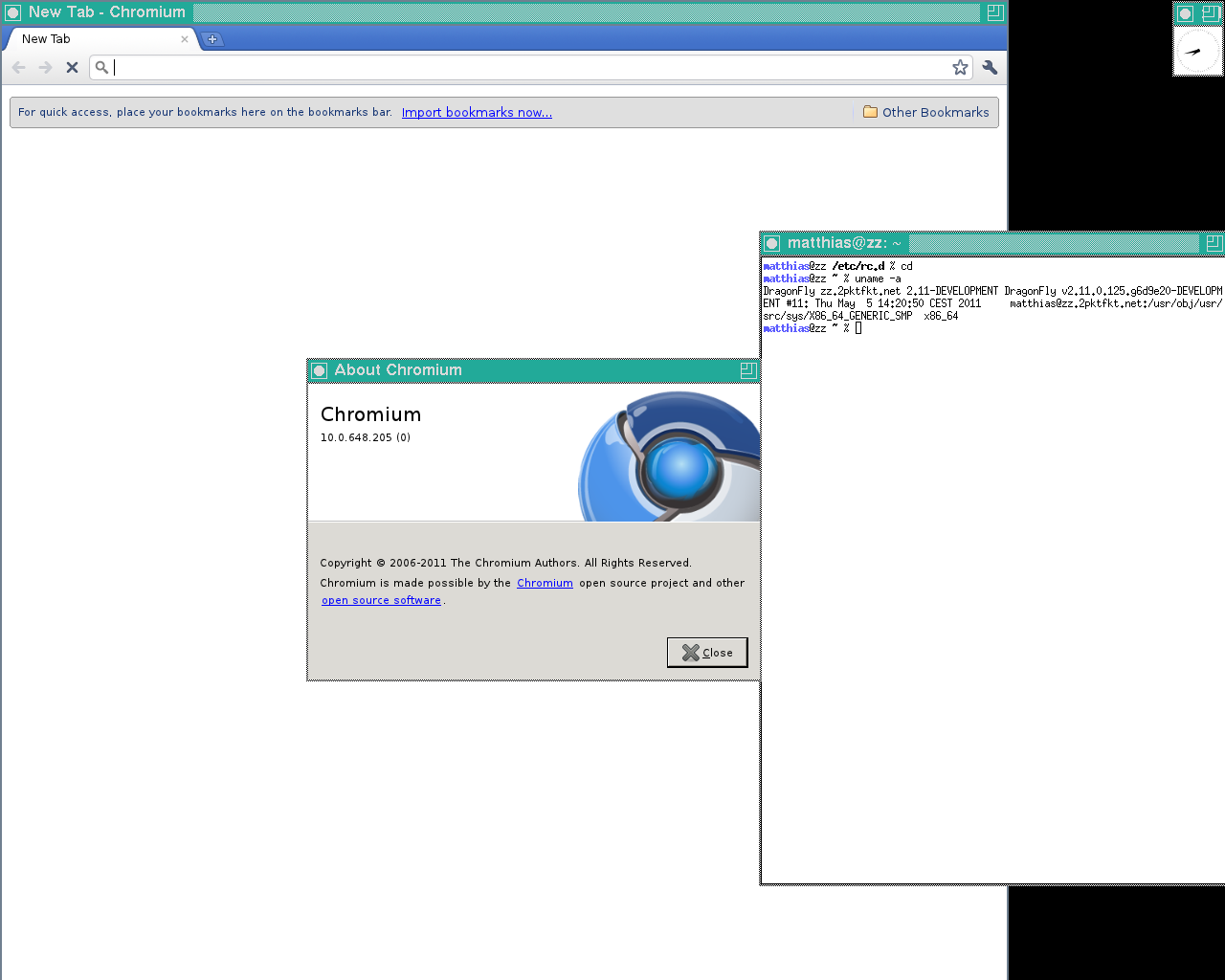
Thanks to Matthias Rampke, Chromium builds on DragonFly. He’s posted with notes and even a screenshot, and has a working i386 binary.
I didn’t think of this, but I needed it: if you have an older Hammer system that now can perform deduplication because you upgraded to DragonFly 2.10, make sure to add it to the configuration for that file system, or else it won’t run.
Thanks to John Marino, the one dependency needing libgnuregex is gone, as is the software itself. I didn’t even know libgnuregex was there.
If you have a really old DragonFly system, meaning you’ve been upgrading it since version… 1.8 (I think?), you may have libpthread linked to libc_r instead of libxu. This means that if you have a system that old, you will now need to set THREAD_LIB or just recompile your pkgsrc programs on your next upgrade to something after DragonFly 2.10. I don’t think this is going to apply to a lot of people.
(I hope I got the lib details right…)
Let’s see, what do I have now…
- Did you know we just released DragonFly 2.1? Neither did I.
- The AppleCrate II (][?), a set of parallel Apple //e systems. It makes me so happy. I love to see how
simpleuncomplex the old Apple systems were, almost at the level of programmable logic controllers today. I was struck by the fact that the Apple //e requires less than 5 volts, which means it could run off a USB port. (via lots of places) - Removing the internet’s relics: a call to kill FTP now that it’s 40 years old. There’s no easy alternative, though…
- 20 years of Adobe Photoshop. (via) Obviously that’s not found on any BSD platform, but almost every raster-based image editor out there tries to emulate Photoshop in some way, on every platform. It casts a long shadow. Plus, I remember the Photoshop 2.0 loading screen, so now I feel old.
- Is tech blogging becoming worse? i.e not really tech any more? I’ve mumbled about this before, since this site is arguably a tech blog. Sites tend to diversify and lose focus to grow their audience. You can see the same pattern in the magazine market, back when there was a magazine market. You don’t have to worry about the Digest – I’m targeting BSD users, so I’m totally not growing my audience! (Joking, joking. Readership is staying even to slightly up, over the last while.)
On a separate note that has nothing to do with DragonFly: if you live outside the United States and have a postcard handy, can you send it to “St. John Neumann School, 31 Empire Blvd., Rochester, NY 14609 USA”? My daughters’ school is collecting international postcards this month as part of their geography lesson. It doesn’t have to have anything specific, other than be interesting to 8-year-olds.
ipfilter has now been removed from DragonFly, by Sascha Wildner. We now have “only” ipfw2 and pf for software firewalls.
John Marino has updated the GNU Debugger (GDB) from version 7.0 to version 7.2. The lengthy commit message describes how surprisingly complex the upgrade proved to be.
And here’s one last writeup/introduction for Google Summer of Code projects on DragonFly: kevent part 2. (Apparently school exams prevented this from being written sooner.)
The 10th EuroBSDCon is happening in Maarssen, The Netherlands, October 6th through the 9th. The call for proposals is up until the end of the month.
Matthew Dillon’s been thinking about Hammer, and how to implement clustering well enough to work as a sort of RAID replacement. He’s written up a document describing his plans. Some highlights:
- writable history snapshots
- quotas and accounting
- live rebuilds of data from mirrors
- and the same history, mirroring, and snapshots as before.
It’s going to be a while before this “Hammer 2” becomes a finished product, though, so don’t count on it for the next release.
The May issue of BSD Magazine is out. The cover says “Embedded FreeBSD” as a continuation of last month’s theme, but there’s really a wide mix in there. Of course, there’s a DragonFly news section from me, talking about 2.10. I’ll point at the zsh article that opens the magazine, since every zsh user I’ve met talks about zsh rapturously. Also, the iXSystems ad on page 2 has a rather fun illustration…
Tim Bisson has inital TRIM support working for UFS. His lengthy posting talks about how it’s done, and shows how much it speeds things up. He’s looking for testers, so please try it if you have a SSD. (The usual warnings apply about testing code that specifically deletes things.)
For those not familiar with TRIM in SSD context, here’s the least annoying page with an explanation that I could find in a few seconds of Googling.
The May 2011 issue of the Open Source Business Resource is “Technology Entrepreneurship“. You’ll want to read this because it’s all people who are their own boss, using software they can modify themselves. Seductively nerdy/utopian! They’re continuing the topic for next month’s issue, so if that describes you and you like writing, here’s your chance.
John Marino’s gone on a tear and updated GCC to version 4.4.6, diffutils from 2.87 to 3.0, and texinfo from 4.8 to 4.13. Each commit message that I linked to has plenty of notes on what’s different, so they’re worth following. This is the first update for texinfo in 6 years, so the quantity of updates is not surprising.
Kedar Soparkar applied for Google Summer of Code with DragonFly, but didn’t make the cut with the very few slots we have. So, he’s going to work on his i386 ABI implementation anyway. More student work is always wonderful news.